Loblolly Pine
Scientific Name: Pinus taeda
Category: tree
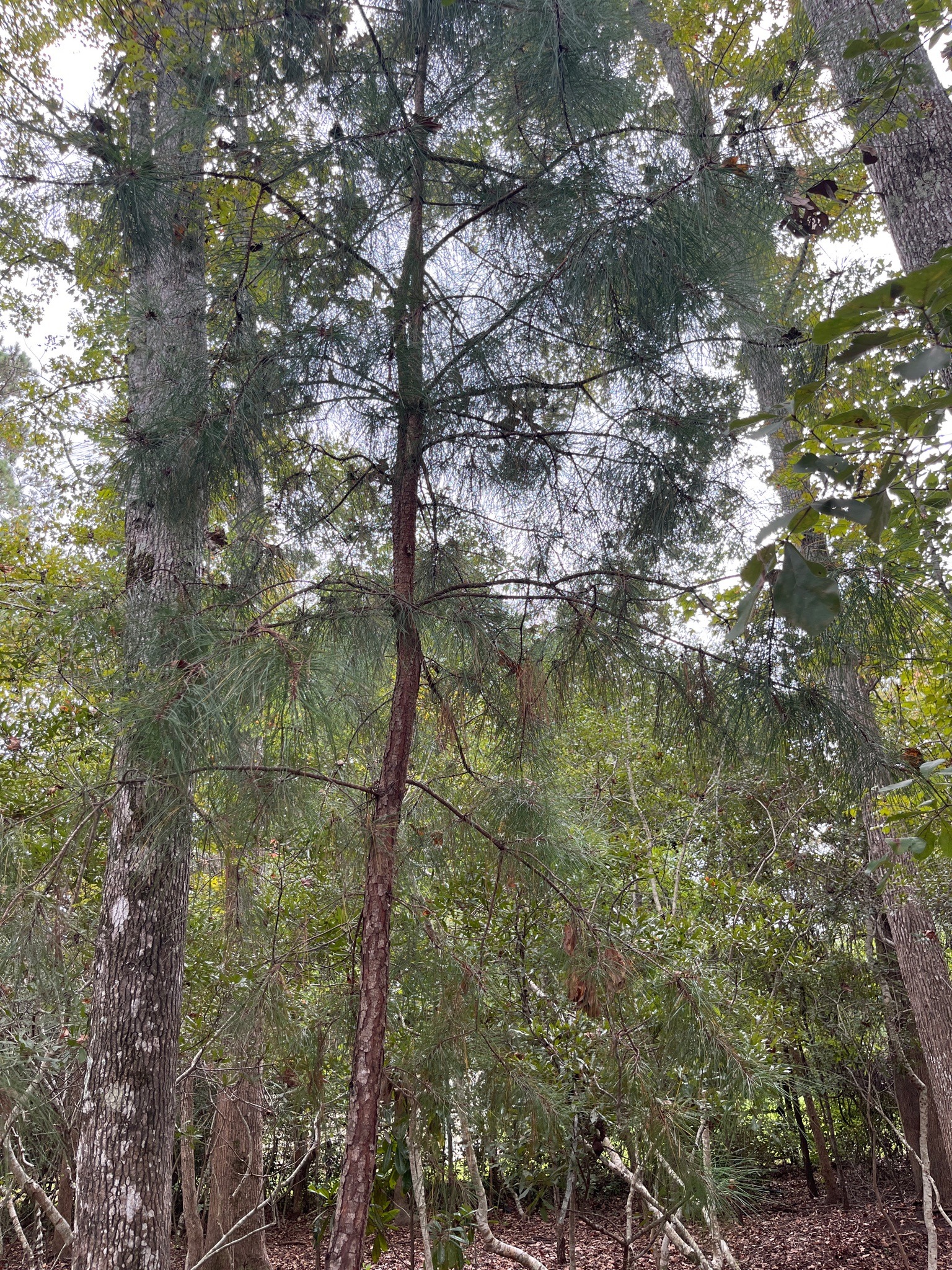
Brief Description
A large, straight-trunked conifer native to the southeastern United States, featuring needles in bundles of three and scaly, reddish-brown bark.
Characteristics
Needles are typically 3 to 9 inches long, yellowish-green, and bundled in groups of three. Cones are 3 to 6 inches long with sharp prickles on the scales. Bark is thick, reddish-brown, and divided into broad, scaly plates.
Habitat
Found across the southeastern United States, commonly in lowlands, old fields, and poorly drained soils, though highly adaptable to various upland sites.
When to Find It
Evergreen tree providing year-round foliage; cones mature in autumn of their second year.
Conservation Status
Least Concern
Ecological Role
Provides essential nesting habitat and food for numerous wildlife species, including the endangered red-cockaded woodpecker. It is also a primary commercial timber species.
Easily Confused With
Longleaf Pine (Pinus palustris), which has longer needles (up to 18 inches) and much larger cones, and Shortleaf Pine (Pinus echinata), which has shorter needles and smaller cones.
Observation Tips
Look up into the forest canopy to spot the characteristic clusters of three needles and dangling cones; binoculars can help identify needle counts and cone details high up.
Interesting Facts
Loblolly pines are among the fastest-growing southern pines and are often the dominant species in secondary succession forests throughout the American South.