Sabal Palm
Scientific Name: Sabal palmetto
Category: tree
Brief Description
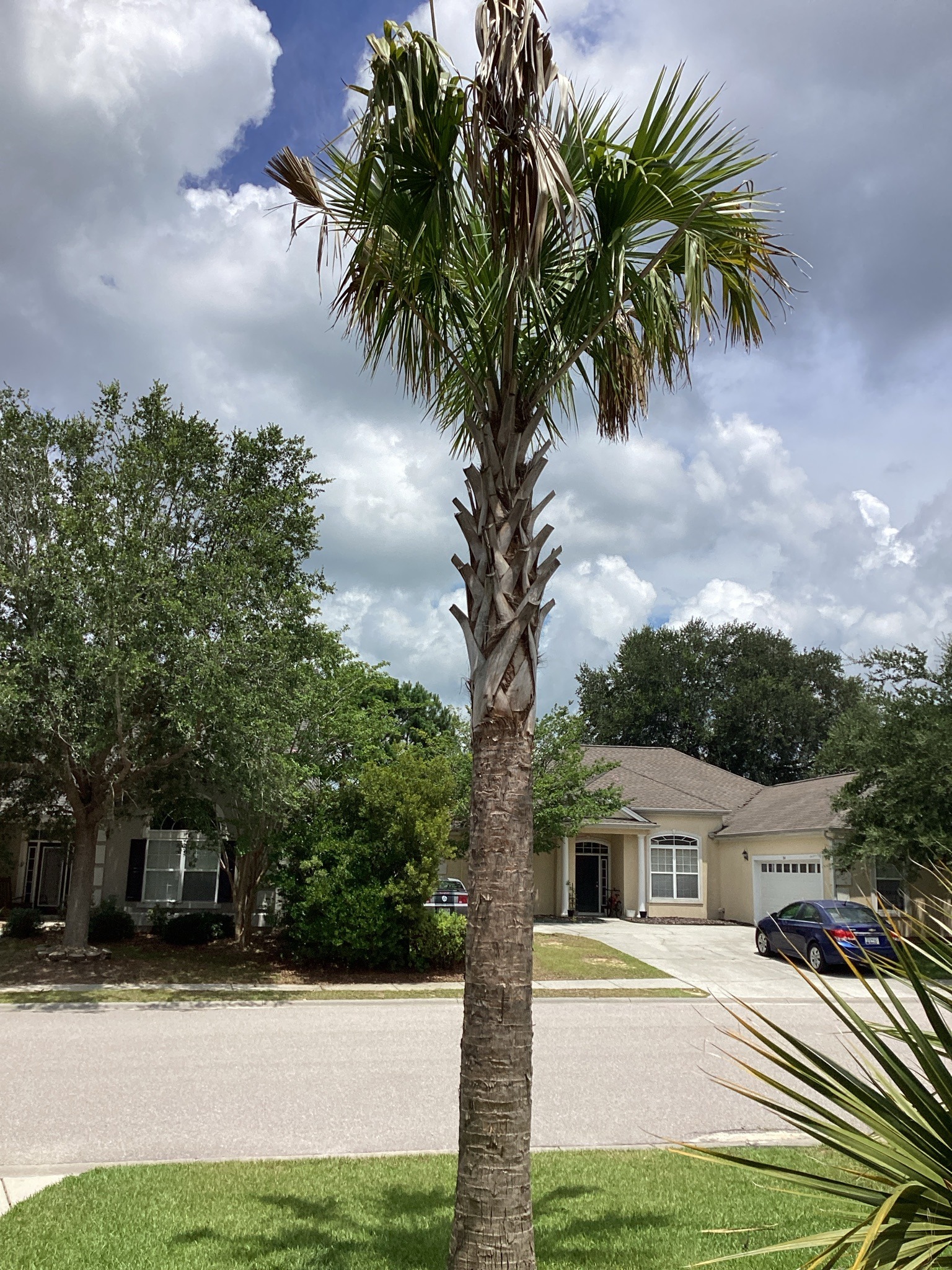
A medium-sized fan palm with a single trunk and large, costapalmate fronds, commonly found in the Southeastern United States.
Characteristics
Distinctive fan-shaped leaves (fronds) with a prominent midrib (costa) that curves slightly. The trunk often retains crisscrossed old leaf bases known as 'bootjacks' or 'boots' near the top, though older trees may have smooth trunks. Small white flowers appear in large clusters, followed by small black fruits.
Habitat
Found in coastal areas, pine flatwoods, hammocks, and along riverbanks; highly salt-tolerant and drought-resistant.
When to Find It
Perennial; blooms typically occur in late spring to summer (May to August).
Conservation Status
Least Concern
Ecological Role
Provides critical nesting sites for birds and bats. The flowers are a major source of nectar for pollinators, and the fruit is a food source for diverse wildlife including raccoons, squirrels, and various bird species.
Easily Confused With
Chinese Fan Palm (Livistona chinensis) has drooping leaf tips; Saw Palmetto (Serenoa repens) is typically shrub-like with saw-toothed petioles, whereas Sabal palmetto has smooth petioles.
Observation Tips
Look for the V-shaped split where the leaf stalk meets the blade. In residential areas, they are often pruned into a 'hurricane cut,' but in the wild, they often host epiphytes like resurrection ferns and golden polypody in their bootjacks.
Interesting Facts
It is the state tree of both Florida and South Carolina. The edible bud of the tree is known as 'heart of palm,' though harvesting it kills the tree. The fibrous trunk was used by early settlers to build forts because it could absorb the shock of cannonballs without splintering.
User Notes
Front yard