Dryad's Saddle
Scientific Name: Cerioporus squamosus
Category: fungi
Brief Description
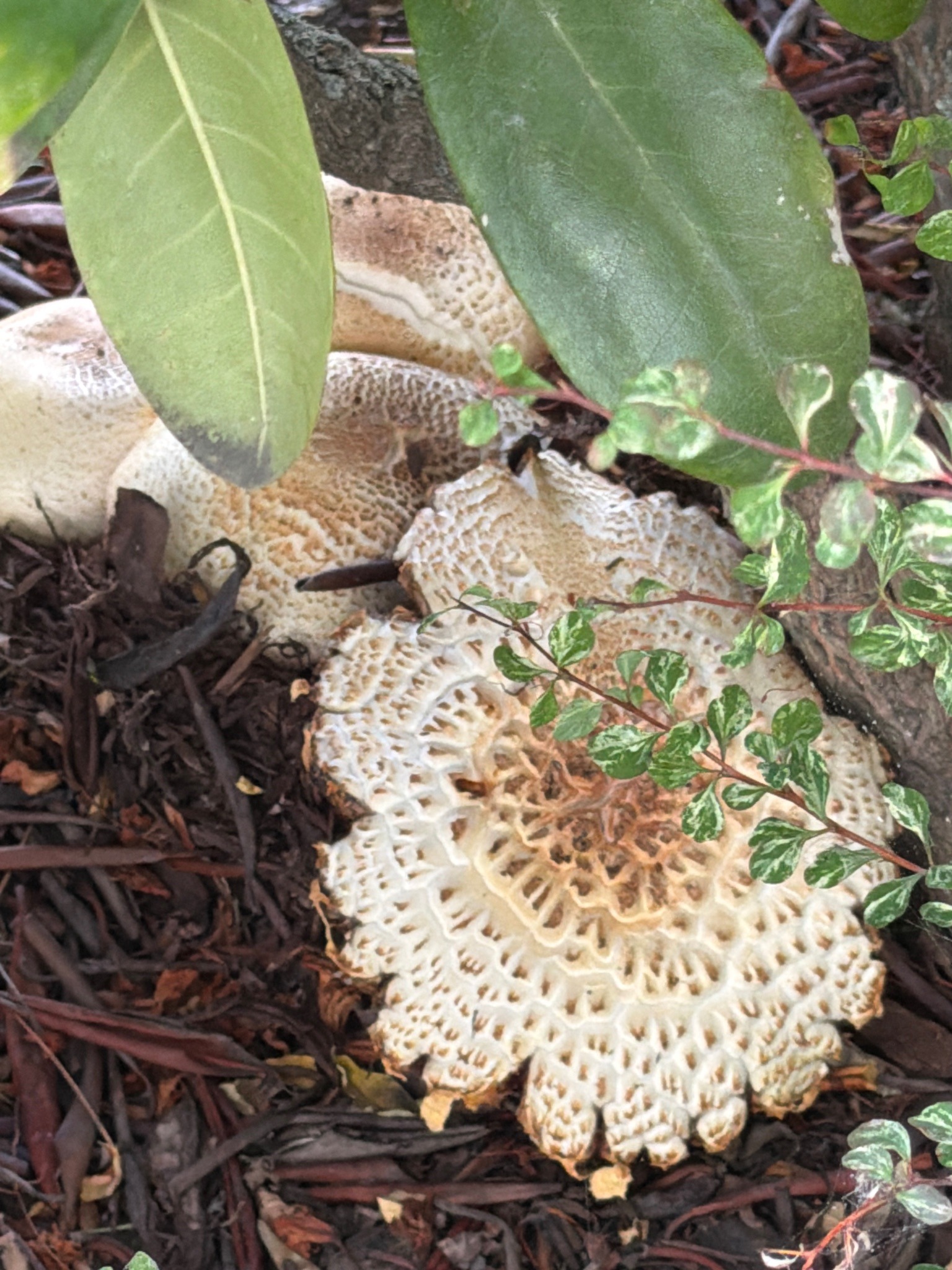
A distinctive bracket fungus growing on wood, easily recognized by its scaly, cream-to-brown upper surface and unique pore structure underneath resembling a net or honeycomb.
Characteristics
Large, fan-shaped to semicircular brackets with a central or lateral stalk attached to wood. The cap is whitish to yellowish-brown, covered in darker brownish scales. The underside features wide, angular pores that look like a honeycomb.
Habitat
Found growing on dead or dying hardwood trees, stumps, and fallen logs, particularly in temperate deciduous forests.
When to Find It
Most commonly found in spring, though it can occasionally appear in autumn.
Conservation Status
N/A
Ecological Role
Acts as a primary saprotroph, breaking down lignin and cellulose in dead wood, thus recycling nutrients back into the forest ecosystem.
Easily Confused With
Can be confused with other bracket fungi like Laetiporus (Chicken of the Woods), but Dryad's Saddle is distinguished by its distinct brown scales and large pores underneath.
Observation Tips
Look near the base of dead hardwood trees or on fallen logs, especially after spring rains when growth is most vigorous.
Interesting Facts
Young specimens are edible and have a distinctive, pleasant aroma often described as smelling faintly of watermelon or cucumber.