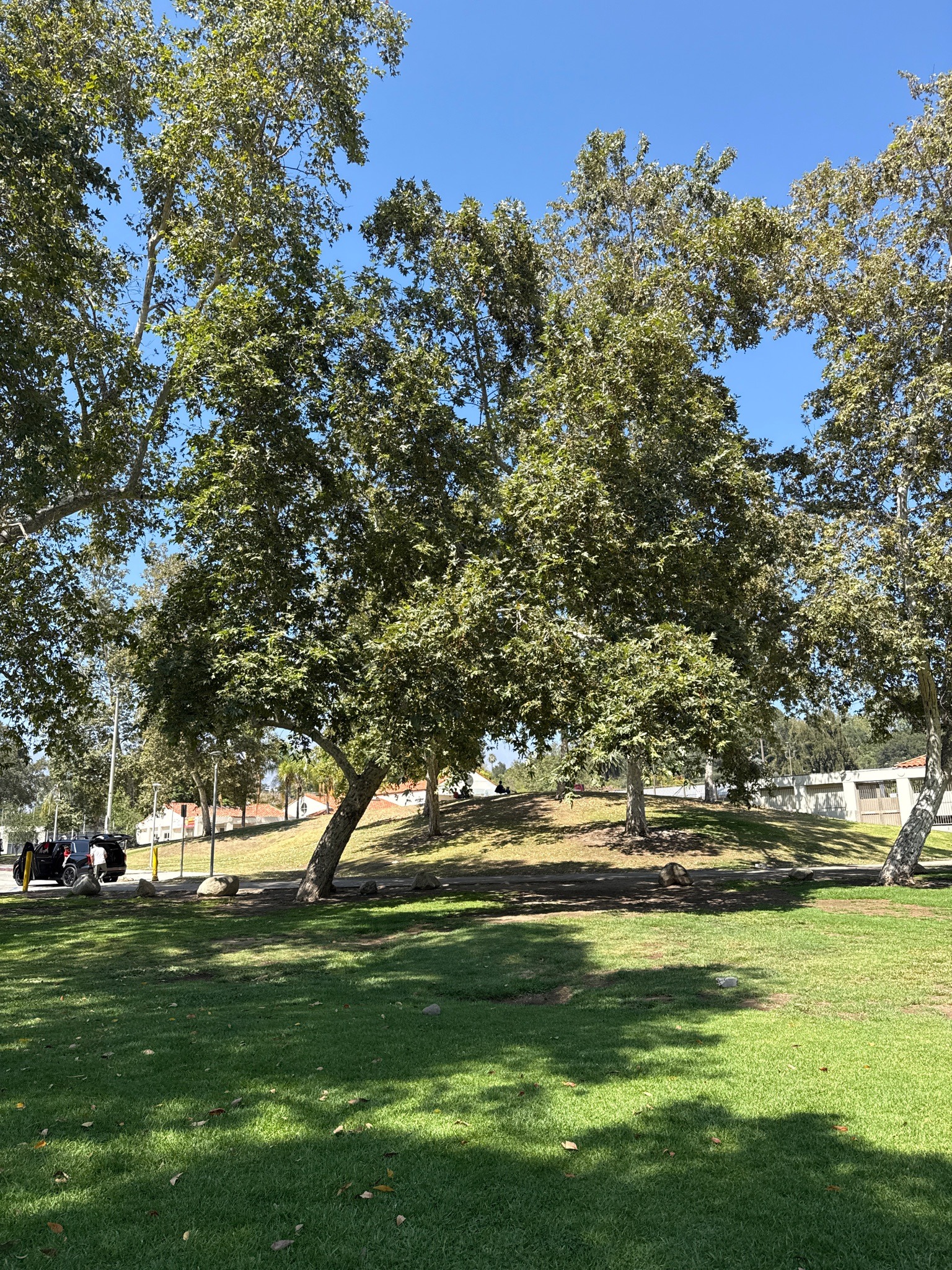
California Sycamore
Scientific Name: Platanus racemosa
Category: tree
Brief Description
A large, fast-growing deciduous tree native to California and Baja California, recognizable by its mottled, peeling bark and large palmate leaves.
Characteristics
Features distinctive bark that peels away in irregular patches to reveal white, gray, and tan layers. Leaves are large, 3-5 lobed, and covered in fine hairs when young. Fruit is a spherical, bristly seed ball that hangs in clusters.
Habitat
Typically found in riparian areas alongside streams, rivers, and canyons, but also widely planted in parks and urban landscapes.
When to Find It
Deciduous, losing its leaves in late fall or winter. Seed balls persist on the tree through winter until they break apart in spring.
Conservation Status
Least Concern
Ecological Role
Provides vital habitat and nesting sites for birds like swifts and hawks. It is a critical component of riparian ecosystems, providing shade that cools water for aquatic life.
Easily Confused With
London Plane Tree (Platanus x acerifolia) which has seed balls in pairs rather than clusters of 3-7 and generally more uniform bark. American Sycamore (Platanus occidentalis) found in the Eastern US.
Observation Tips
Look for the striking white-topped branches in winter when the leaves are gone. In summer, the broad leaves provide dense, cool shade.
Interesting Facts
The wood is very hard and was historically used by Native Americans for making bowls and tools. These trees can live for several hundred years and reach massive sizes with thick, twisted trunks.