Ringless Honey Mushroom
Scientific Name: Desarmillaria caespitosa
Category: fungi
Brief Description
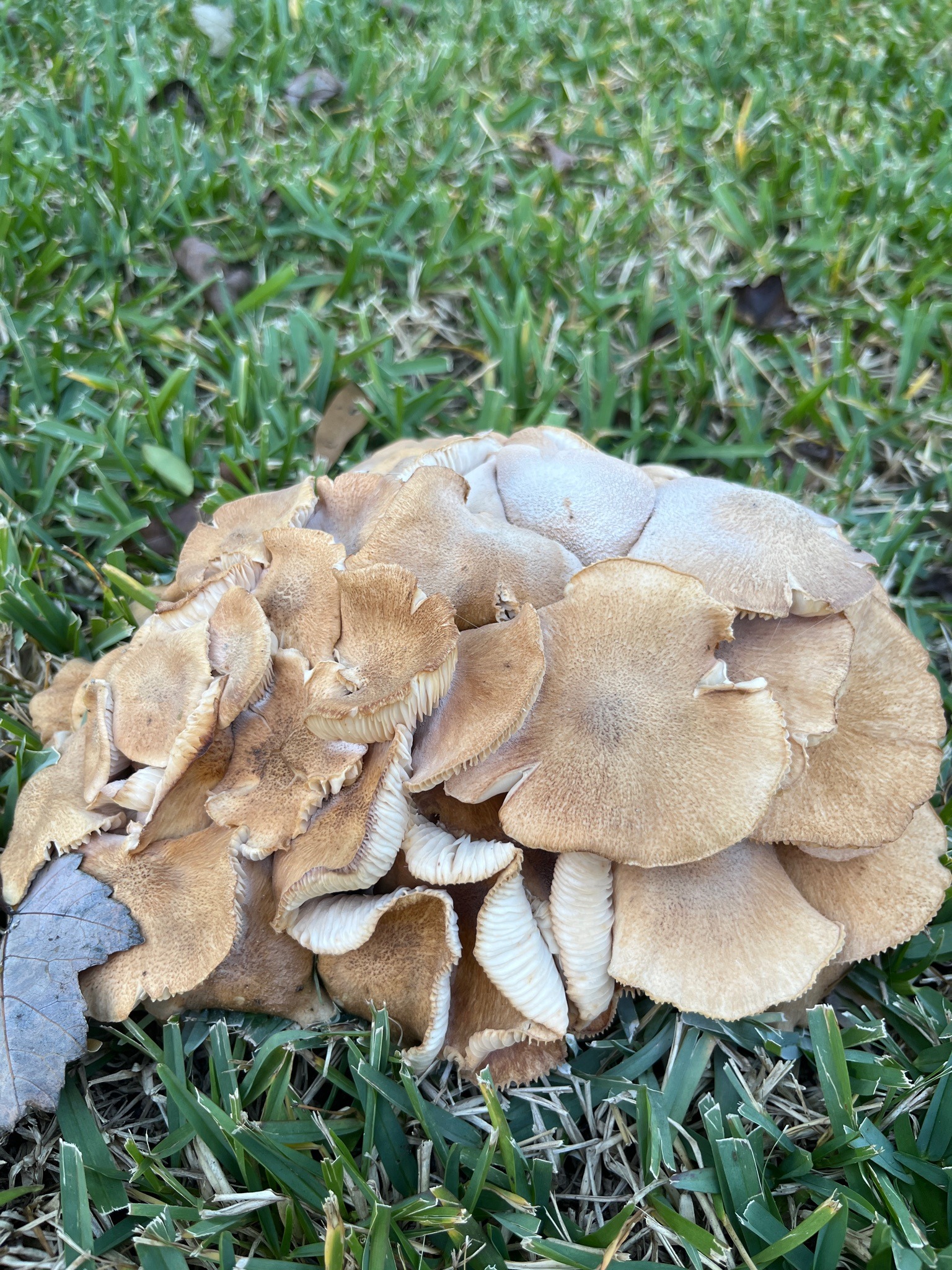
A dense, clustered growth of tan-to-brown mushrooms growing directly from soil or buried wood in a grassy lawn.
Characteristics
Caps are convex to flat, honey-yellow to brownish with fine dark scales, especially near the center. Gills are whitish to cream, becoming discolored or spotted with age, and are attached to slightly decurrent. Stipes are clustered, fibrous, and notably lack a ring or annulus.
Habitat
Found growing in large clusters on lawns, near buried tree roots, or at the base of deciduous trees.
When to Find It
Typically appears in autumn, particularly after heavy rains.
Conservation Status
N/A
Ecological Role
Acts as a pathogen and decomposer of wood, playing a significant role in forest and ecosystem nutrient recycling, though it can be parasitic to living trees.
Easily Confused With
Other Armillaria species which generally possess rings on their stems; Jack-o'-Lantern mushroom which has bright orange gills and is toxic.
Observation Tips
Look for dense clusters emerging directly from turf or around old tree stumps, often appearing overnight after rain.
Interesting Facts
Ringless honey mushrooms are part of one of the largest living organisms on Earth, connected by underground fungal networks (rhizomorphs), though individual clusters sprout above ground.