American Beech
Scientific Name: Fagus grandifolia
Category: tree
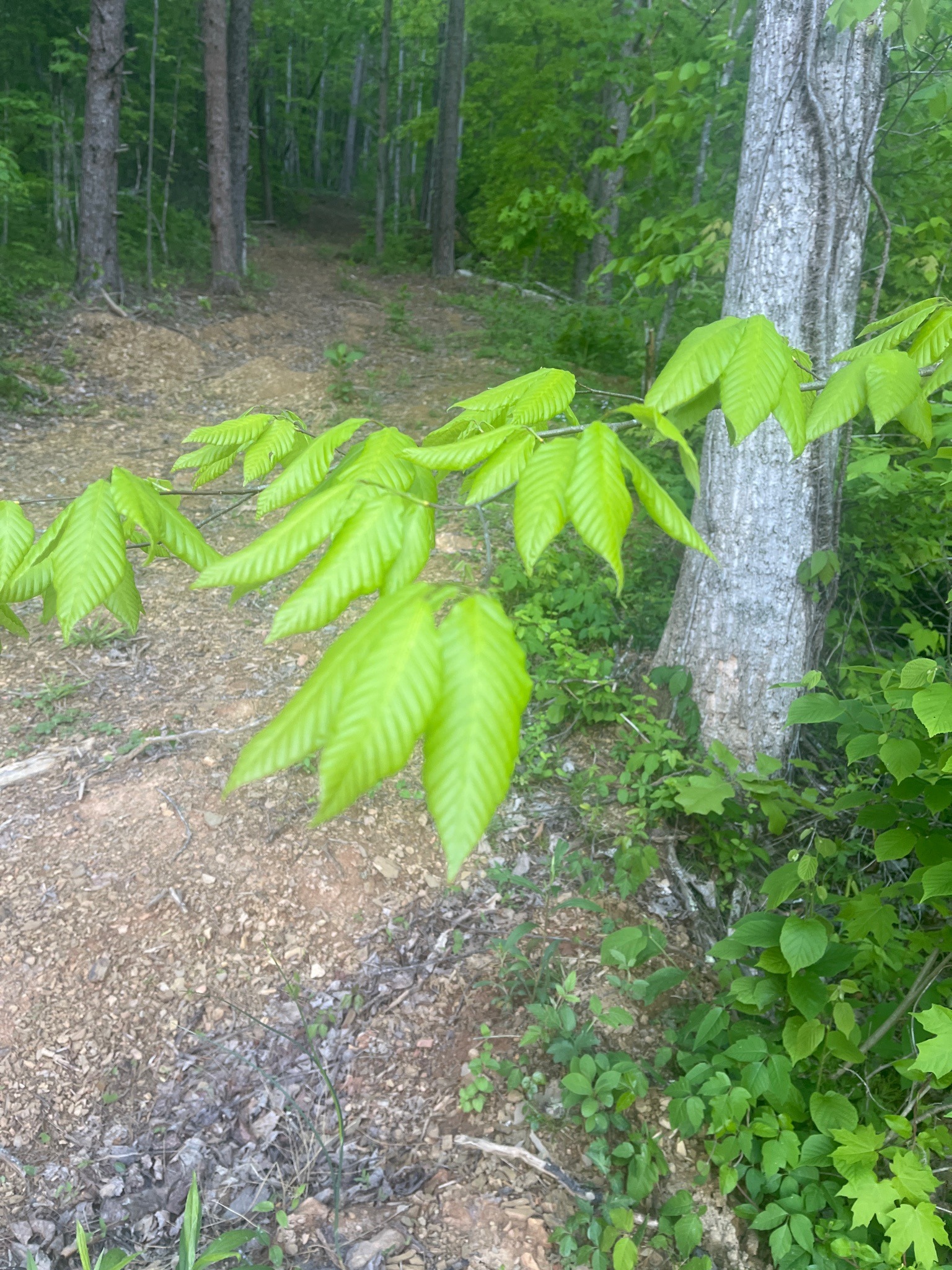
Brief Description
A slow-growing deciduous tree known for its smooth gray bark and distinctively veined leaves.
Characteristics
The leaves are elliptical with pointed tips, prominently parallel veins, and coarsely serrated margins. The bark is remarkably smooth and light gray even as the tree matures. New spring foliage, as seen here, is a vibrant lime green.
Habitat
Found in rich, well-drained loamy soils of bottomlands and upland slopes, often in climax deciduous forests.
When to Find It
Deciduous; leaves turn golden-bronze in autumn and often persist on the tree through winter (marcescence).
Conservation Status
Common, but threatened in many areas by Beech Bark Disease.
Ecological Role
Produces beech nuts that are a vital food source for birds, squirrels, bears, and other wildlife. It often forms large colonies via root sprouts.
Easily Confused With
Hornbeam (Carpinus caroliniana) and Birches (Betula spp.) have similar leaf shapes but their bark is textured, shreddy, or flaky, unlike the smooth bark of the Beech.
Observation Tips
Look for the smooth 'elephant skin' bark. In winter, the long, slender, cigar-shaped buds are extremely distinctive.
Interesting Facts
American Beech trees are often carved into by people because of their smooth bark, which does not heal over time, leaving scars for the life of the tree. They can live for 300 to 400 years.