Thorny Olive
Scientific Name: Elaeagnus pungens
Category: plant
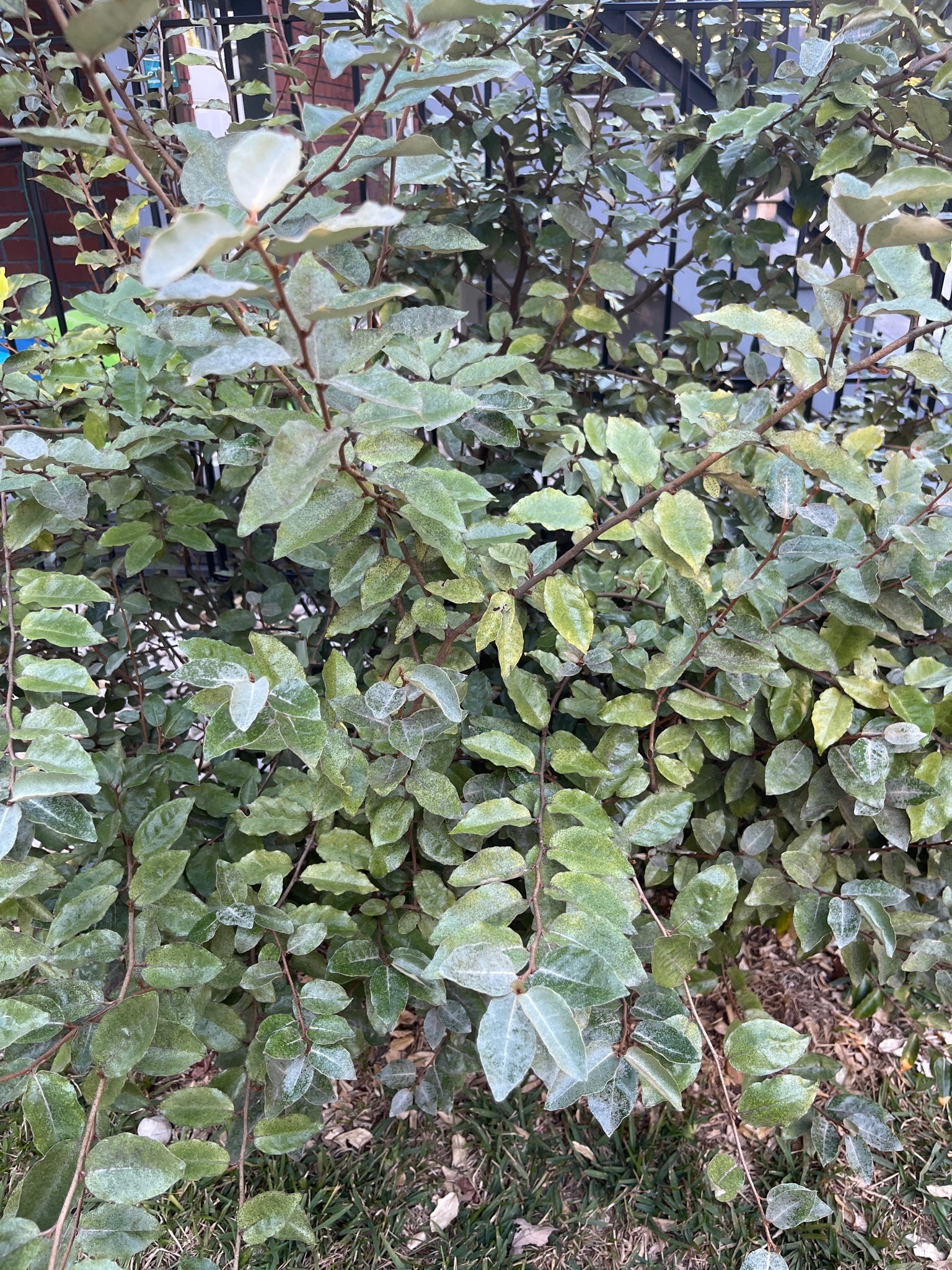
Brief Description
A large, dense evergreen shrub characterized by its silvery-green leaves, brownish scales on young stems, and fragrant autumn flowers.
Characteristics
Leaves are alternate, simple, oblong to oval, with wavy margins, glossy green above, and covered with dense silvery-brown scales underneath. Stems often feature woody thorns. Small, highly fragrant, bell-shaped whitish flowers appear in autumn.
Habitat
Found in disturbed areas, forest edges, roadsides, and urban landscaping. Highly adaptable to various soil types and light conditions.
When to Find It
Evergreen year-round; blooms in autumn (October to November) with small fruits ripening in spring.
Conservation Status
Not applicable
Ecological Role
Provides food and cover for birds and small mammals. However, it is considered invasive in many regions outside its native range because it fixes nitrogen and crowds out native understory vegetation.
Easily Confused With
Silverthorn can resemble other Elaeagnus species such as Autumn Olive (Elaeagnus umbellata), which has deciduous leaves with more prominent dots, or Russian Olive (Elaeagnus angustifolia), which is typically a small tree with narrower, completely silver leaves.
Observation Tips
Look for the distinctive metallic silvery-green underside of the leaves and rusty brown scales on the young twigs. Approach in autumn to experience the intense, sweet fragrance of the small hidden flowers.
Interesting Facts
Thorny olive fixes atmospheric nitrogen through actinomycetes in its root nodules, allowing it to thrive in poor soils. It is native to Asia (China and Japan) and was introduced to North America as an ornamental hedge plant.