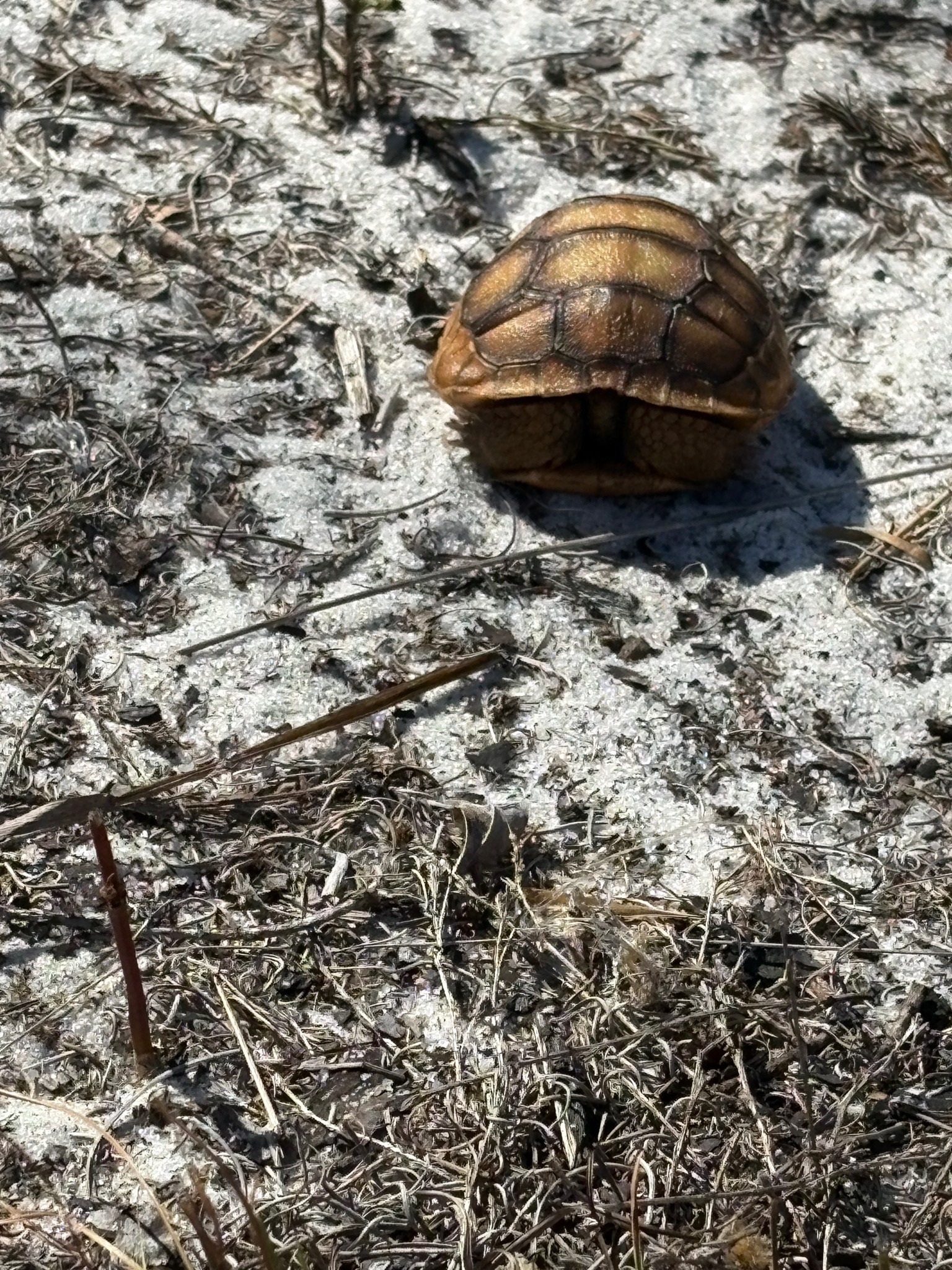
Gopher Tortoise Hatchling
Scientific Name: Gopherus polyphemus
Category: reptile
Brief Description
A young land-dwelling tortoise with a dome-shaped, tan-to-brown shell, adapted for burrowing in sandy soils.
Characteristics
Features a high-domed carapace (top shell) with prominent scutes that display growth rings. Hatchlings often have a yellowish or orangish center to each scute. They have thick, stumpy, scale-covered elephantine back legs and shovel-like front legs for digging.
Habitat
Requires well-drained, sandy soils for burrowing and an open canopy to allow for low-growing forage plants. Commonly found in pine sandhills, scrub, and coastal dunes.
When to Find It
Most active during the day from spring through fall, especially during the morning hours. Hatchlings typically emerge from nests between August and October.
Conservation Status
Vulnerable / Threatened (status varies by state; federally listed in the western part of its range).
Ecological Role
A 'keystone species' whose deep burrows provide essential shelter for over 350 other species, including indigo snakes, burrowing owls, and gopher frogs.
Easily Confused With
Box turtles, which have a hinged plastron (bottom shell) allowing them to close up completely, whereas gopher tortoises cannot fully retreat and lack a hinge. Coastal gopher tortoises are sometimes confused with sea turtle hatchlings, but gopher tortoises have stump-like feet rather than flipppers.
Observation Tips
Observe from a distance and avoid handling. In many areas, it is illegal to touch or move them without a permit. Watch for their distinctive large burrow entrances with a 'shelf' of loose sand outside.
Interesting Facts
Gopher tortoise burrows can reach lengths of up to 40 feet and depths of 10 feet. They are the only tortoise naturally found east of the Mississippi River in North America.