False Solomon's Seal
Scientific Name: Maianthemum racemosum
Category: plant
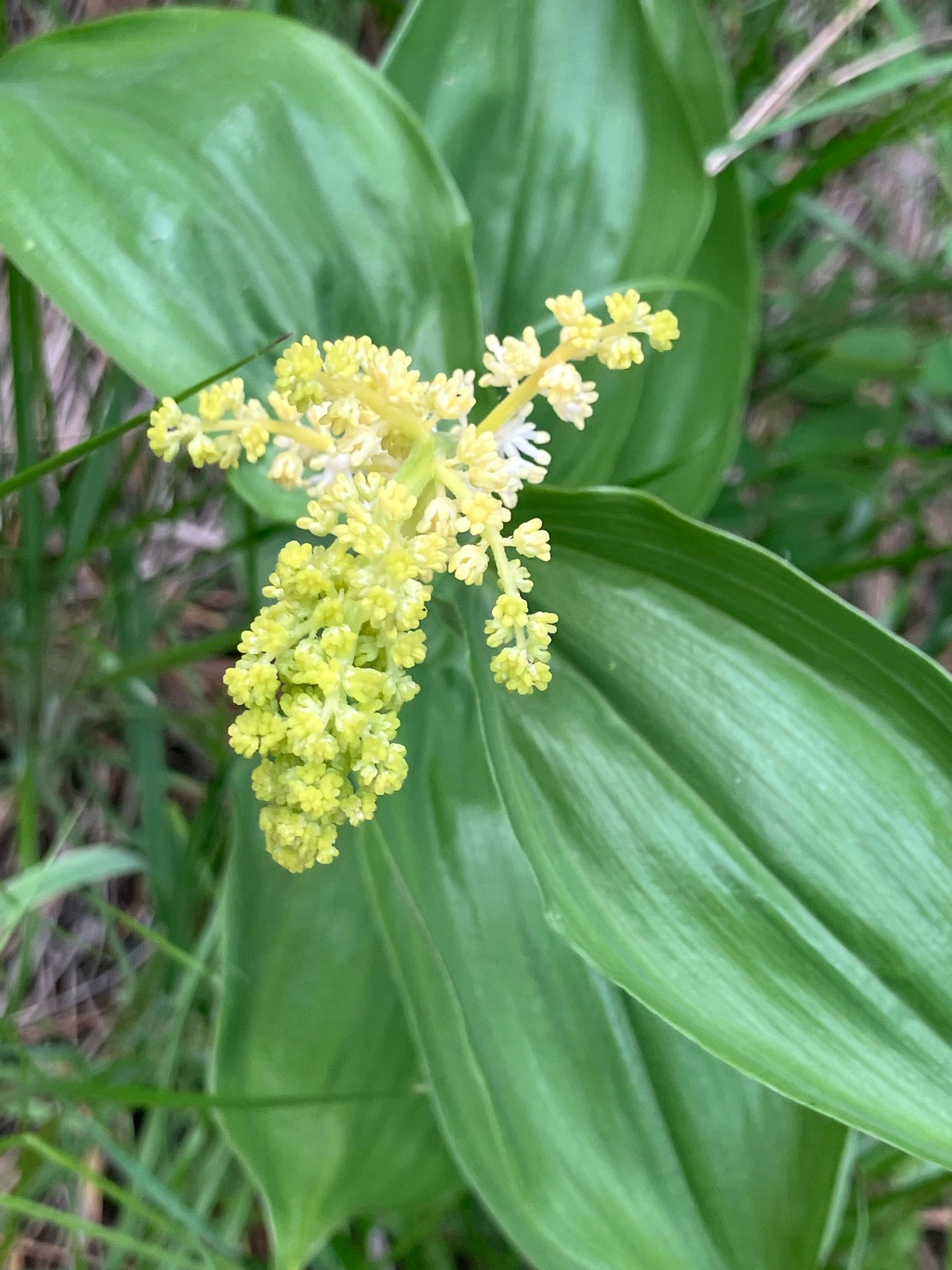
Brief Description
A woodland perennial plant known for its terminal cluster of small white or cream flowers and large, arching leaves.
Characteristics
Broad, oval-shaped leaves with parallel veins arranged alternately on a single arching stem. The flowers are small, star-shaped, and grow in a branched cluster (panicle) at the tip of the stem. Produced berries turn from green to speckled red to solid ruby-red.
Habitat
Shaded woodland floors, forest edges, and thickets.
When to Find It
Blooms in late spring to early summer (May to June). Berries appear in late summer and fall.
Conservation Status
Secure in most of its range, though may be locally rare in specific regions.
Ecological Role
Provides nectar for bees, flies, and beetles. The red berries are a food source for various birds and small mammals.
Easily Confused With
True Solomon's Seal (Polygonatum biflorum), which has flowers hanging in pairs from the leaf axils along the stem rather than a cluster at the tip.
Observation Tips
Look for it in rich, moist deciduous forests. It is best identified when blooming to distinguish it from its 'True' relative. Reach for the tip of the plant to find the flowers.
Interesting Facts
The plant was formerly classified in the Smilacina genus. Despite the name 'False', it is a beautiful native wildflower that holds its own in forest garden settings.