Eastern Redcedar
Scientific Name: Juniperus virginiana
Category: tree
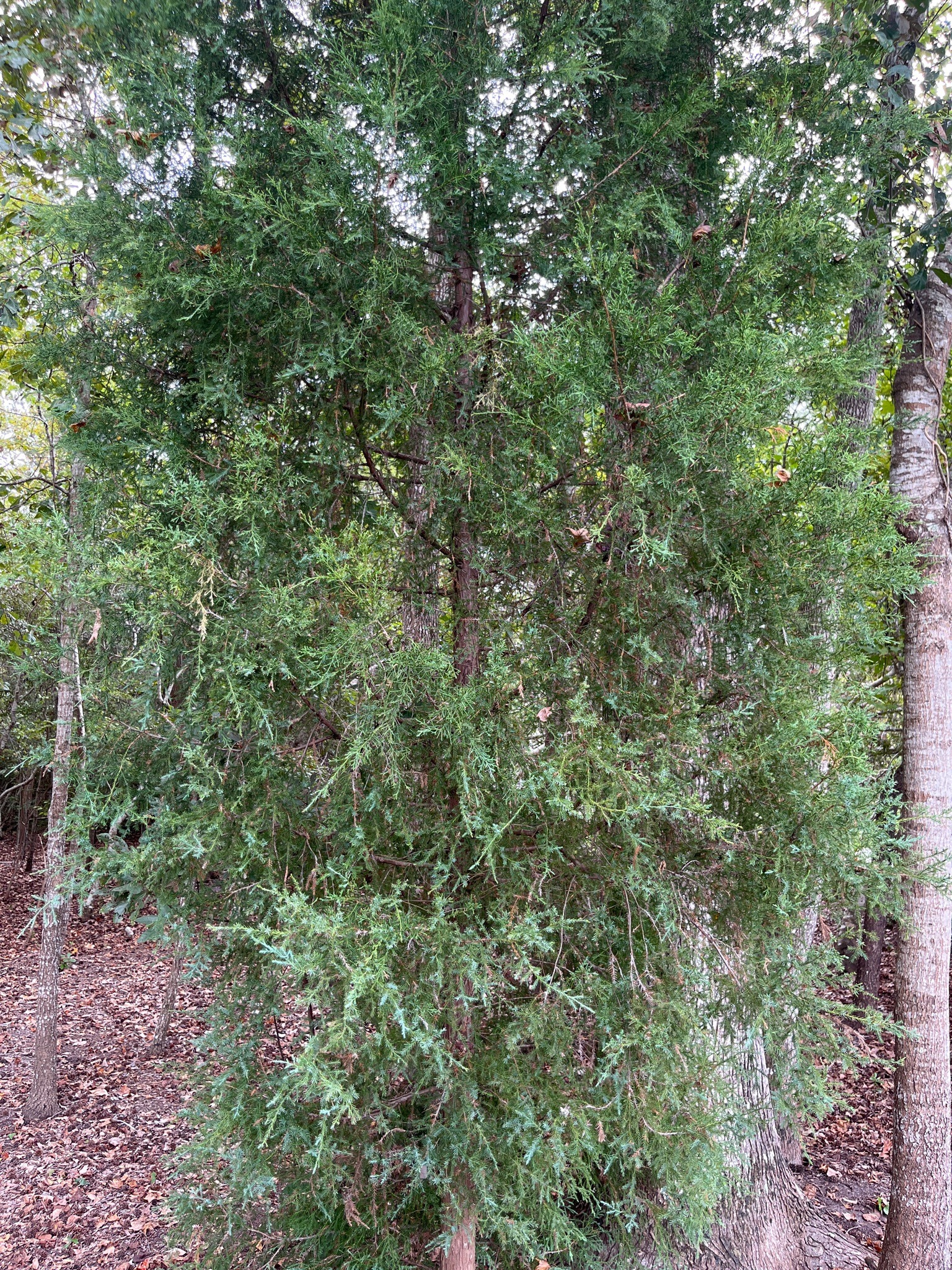
Brief Description
An evergreen conifer featuring dense, scale-like leaves, reddish-brown shredding bark, and a dense, columnar or pyramidal shape.
Characteristics
Evergreen tree with two types of leaves: scale-like leaves on mature twigs and sharp, needle-like leaves on young growth or vigorous shoots. Bark is reddish-brown and peels off in long, thin strips. Produces small, bluish-white, berry-like cones on female trees.
Habitat
Found in old fields, pastures, along fence rows, and on dry rocky ridges or limestone glades; highly adaptable to various soil conditions.
When to Find It
Evergreen, visible year-round. Female cones mature and become most prominent in autumn and winter.
Conservation Status
Least Concern
Ecological Role
Provides crucial winter cover and nesting sites for many bird species, such as cedar waxwings and eastern bluebirds, which also feed on its fleshy cones.
Easily Confused With
Can be confused with other junipers or arborvitae (Thuja species). Distinguished by its reddish shredding bark and combination of scale-like and needle-like leaves.
Observation Tips
Look for its distinct pyramidal shape in abandoned fields or forest edges. Be mindful that mature trees are either male or female, with only females producing the berry-like cones.
Interesting Facts
Despite its common name, the Eastern Redcedar is not a true cedar (Cedrus) but rather a juniper. Its aromatic wood is naturally rot-resistant and frequently used for cedar chests, fence posts, and pencils.